
EverBright
Case Study in Strategic Product Design
June 2024 - July 2025
Solar Proposal Redesign
Utilizing user research and scalable design to solve an industry wide problem costing EverBright millions.
EverBright, a company focused on residential solar financing and design, was dealing with high rates of homeowner delinquency due to excessive homeowner dissatisfaction, deceptive sales practices, and poorly defined educational materials.Working with external sales representatives, EverBright had no presence during in the sales process. The materials that did make it to the homeowners were convoluted, and easy to misunderstand. This led to homeowners not understanding their payments, the impact of solar, and the extent of EverBright’s involvement.This problem plagued other solar competitors and cost EverBright alone more than 100 million in 2024/2025.
Impact
$42 million
Potential risk savings by improving proposal views before contract signing by 60%.
$42 million
Potential risk savings by improving proposal views before contract signing by 60%.
$42 million
Potential risk savings by improving proposal views before contract signing by 60%.
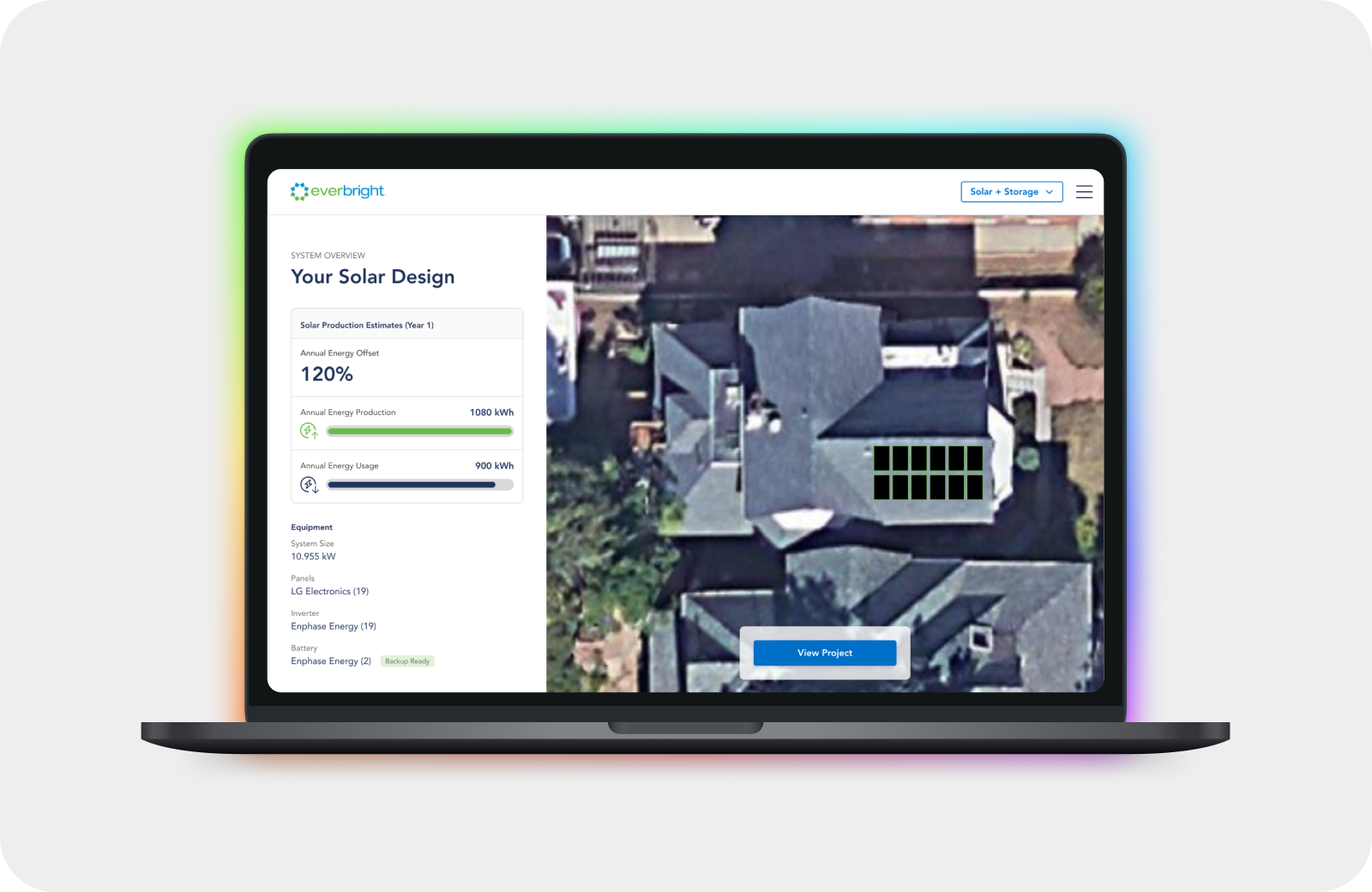
Joining the Team
I joined EverBright in 2023 as a Senior Product Designer, and through 2024 I helped to design new features for the B2B, Solar Design and Financing platform with-in EverBright.
In the summer of 2024, I changed teams and focuses to B2C, Homeowner-facing support and education products. As I shifted into this space I was tasked to lead the design efforts to solve for the 3 major problems plaguing EverBright.
Core Problems
Homeowners dissatisfaction and delinquency.
The core problem is our end customer is unsatisfied, leading to financial delinquencies, poor brand reputation, and legal battles. Nothing outranks this priority, but it still leaves us with many questions.
Complicated and poorly defined content.
The content EverBright used had clearly not been updated in many years. The existing materials leaned into selling more than informing. We quickly learned that sales reps were not using our provided tools or materials for homeowner education.
Improper and deceptive sales practices.
Sales reps are incentivized to close deals quickly, and that in turn means some information is missing. Homeowners, of course want as much information as possible to be as informed as possible. This obvious tension must be solved by EverBright to salvage both relationships.
Strategy
These problems were actively effecting the business and could not wait for long research and development cycles, so we needed to be scrappy in our strategy.We needed to answer the questions critical to our understanding of the problem, but while we were learning, we could tackle the foundational work and any clear improvements. As timing with other initiatives worked out we began with research on the sales rep while we solved direct content issues. This would inform our direction towards more complete solutions past content updates, like new features or process improvements that may require more product strategy.Once we had some early solutions and improvements designed, and we had successfully set up research infrastructures with homeowners, we would then test our solutions while answering our questions about the sales process from the lens of the homeowner.Lastly we would implement yet unknown feature and process improvements based on our research learnings to solve for the core problems outside of our content.
Stage 1.
Utilizing Research and Designing in Parallel
Naturally when you are left with this many questions, you have to start with research. There was much we wanted to learn about the sales rep, the homeowner, and the sales process as a whole.Research was a challenge at EverBright. There were no existing structures, and no immediate ways to contact sales reps or homeowners due to internal restrictions.With problems of this scale, we could not wait on building research infrastructures. So as we began research, we needed to get a start on reworking content and the core materials.
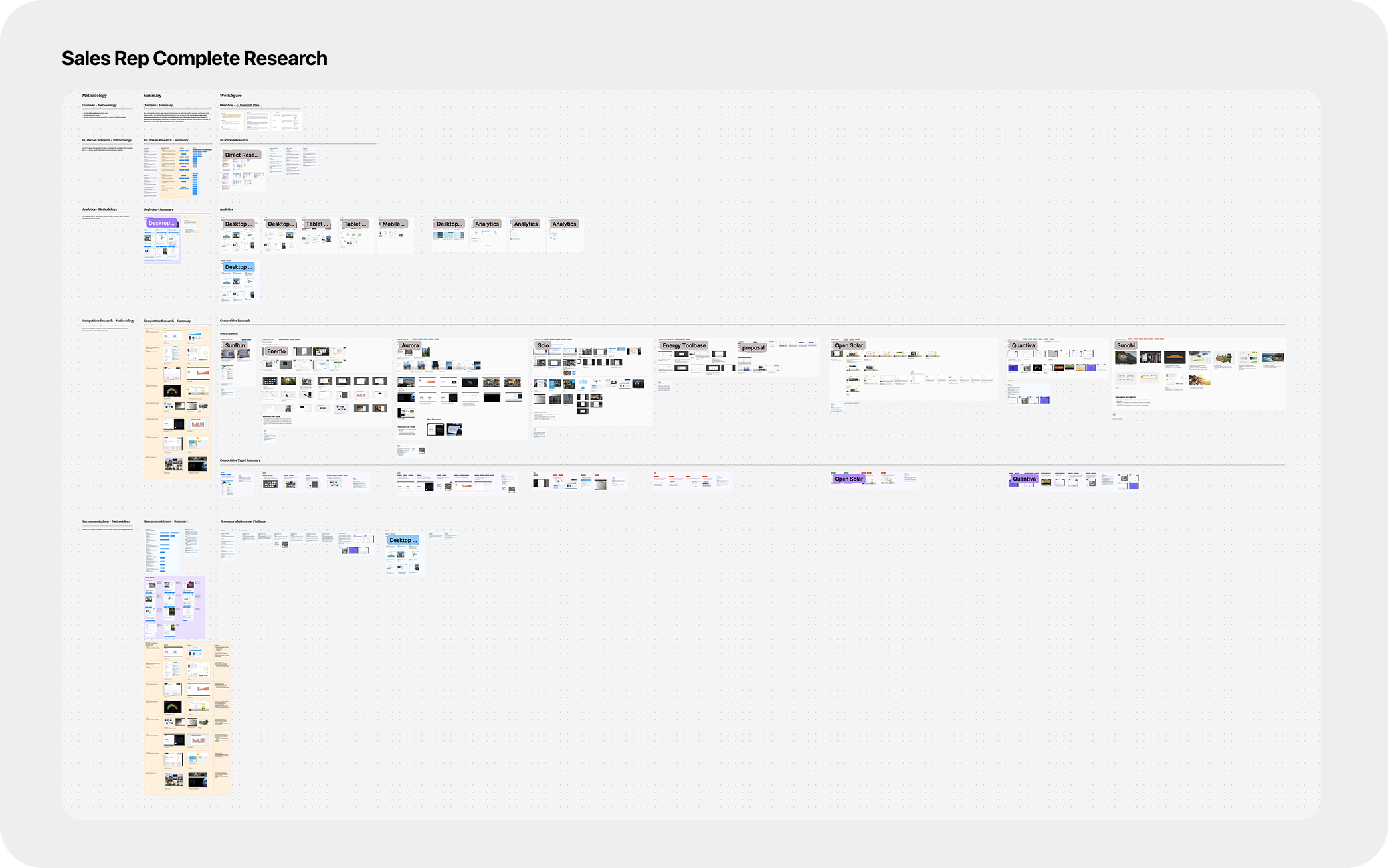
Sales Reps Research
As I began with this new team, a partner team focused on solar design tools for sales reps began their own research efforts. Luckily we were able to use their infrastructure, and interviews to insert our own questions. This allowed us to begin research faster, get a more educated start on content redesigns, as well as assist their team in analyzing and sharing research results.
Through this research we learned that the proposal was not being used. Sales reps were instead selling through conversation, leaving very little behind for homeowners to refer to. They wanted to sell reactively based on homeowner needs, and without complete control over the content, sales reps did not want to use our materials. Specifically, reps found our content to have too much unnecessary information, with not enough focus on terms of service or guarantees.
Initial learnings from our sales reps confirmed our strategy to begin reworking content with the idea of simplifying and de-risking our materials. Understanding that it would be an uphill battle to encourage or force sales reps to use our content, we refocused on directing our efforts on the homeowner.
Simplifying Content and Removing Risk
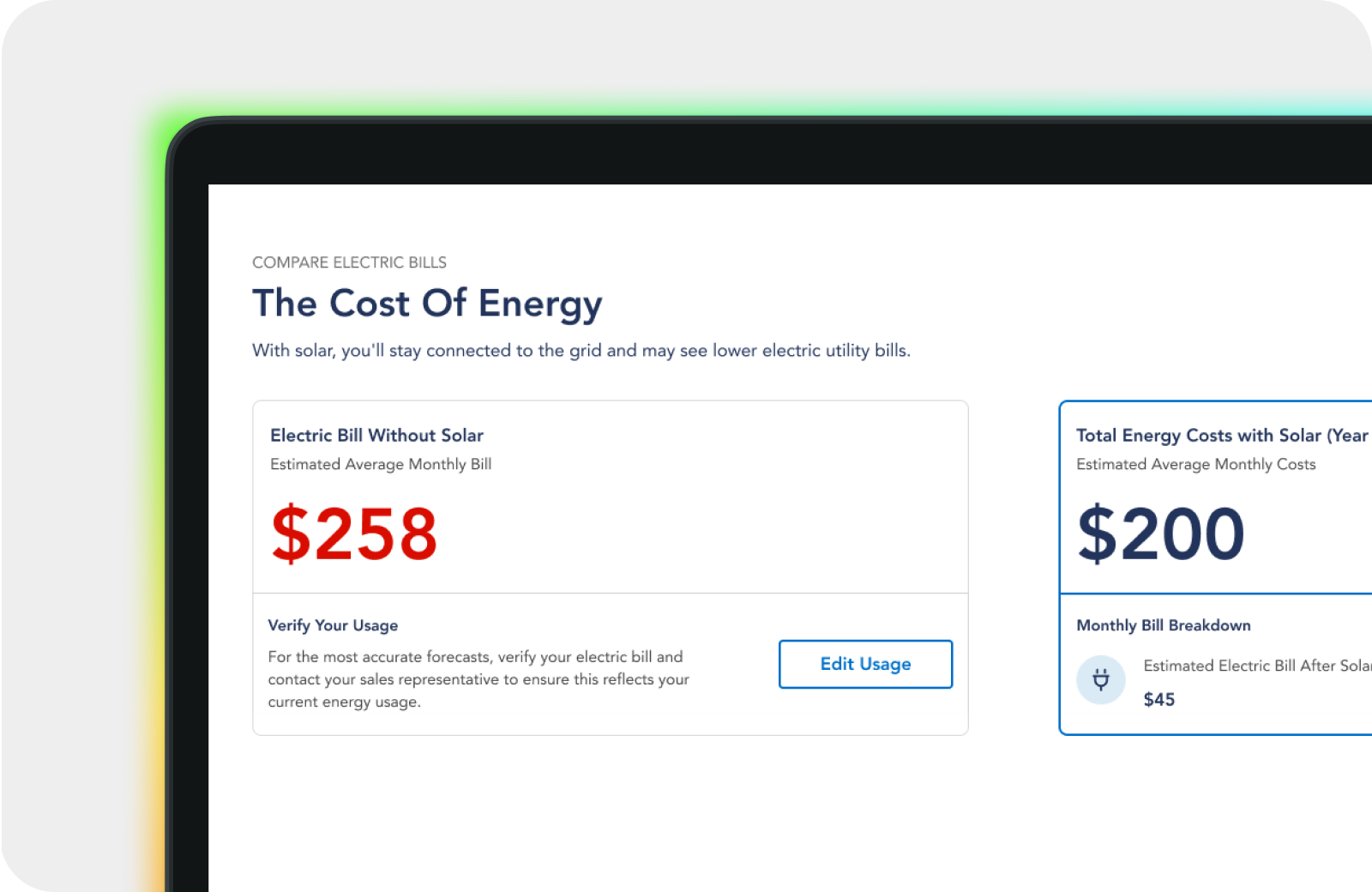
The first task behind updating our content was refining the existing content and design structures. The existing structure had no rules around spacing, character limits, or responsive behavior. The most common device type used for the proposal was a tablet, and in the existing state, the tablet view was broken. So our first task as to create consistent spacing rules and applied responsive views that prioritized tablet, mobile, and pdf printing. For this I oversaw a Junior Designer and led them through this process.
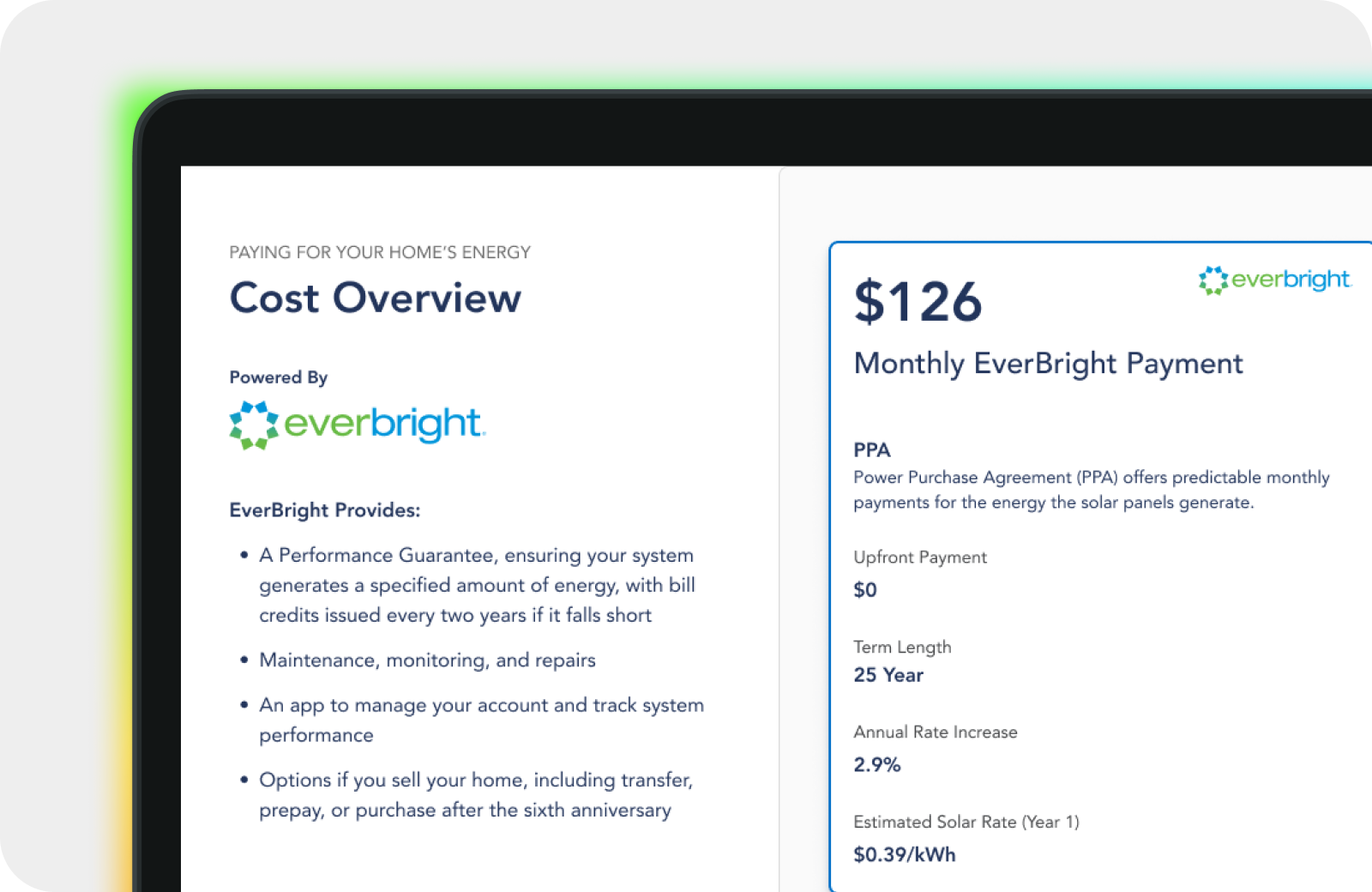
The next challenge was to work through our disclaimers. With the current content being incorrect and rife with legal and compliance issues, we needed to work with our internal partners to rework this content. Legal and compliance naturally take time with this content, so we started our content updates by sending them the required and expected updates.
Finally we began updating the content. We knew that easy wins would come with removing unknown terms, and simplifying language around complex issues. Next, using the sales rep research, we knew terms and ideas that needed to be added.
Stage 1.
Utilizing Research and Designing in Parallel
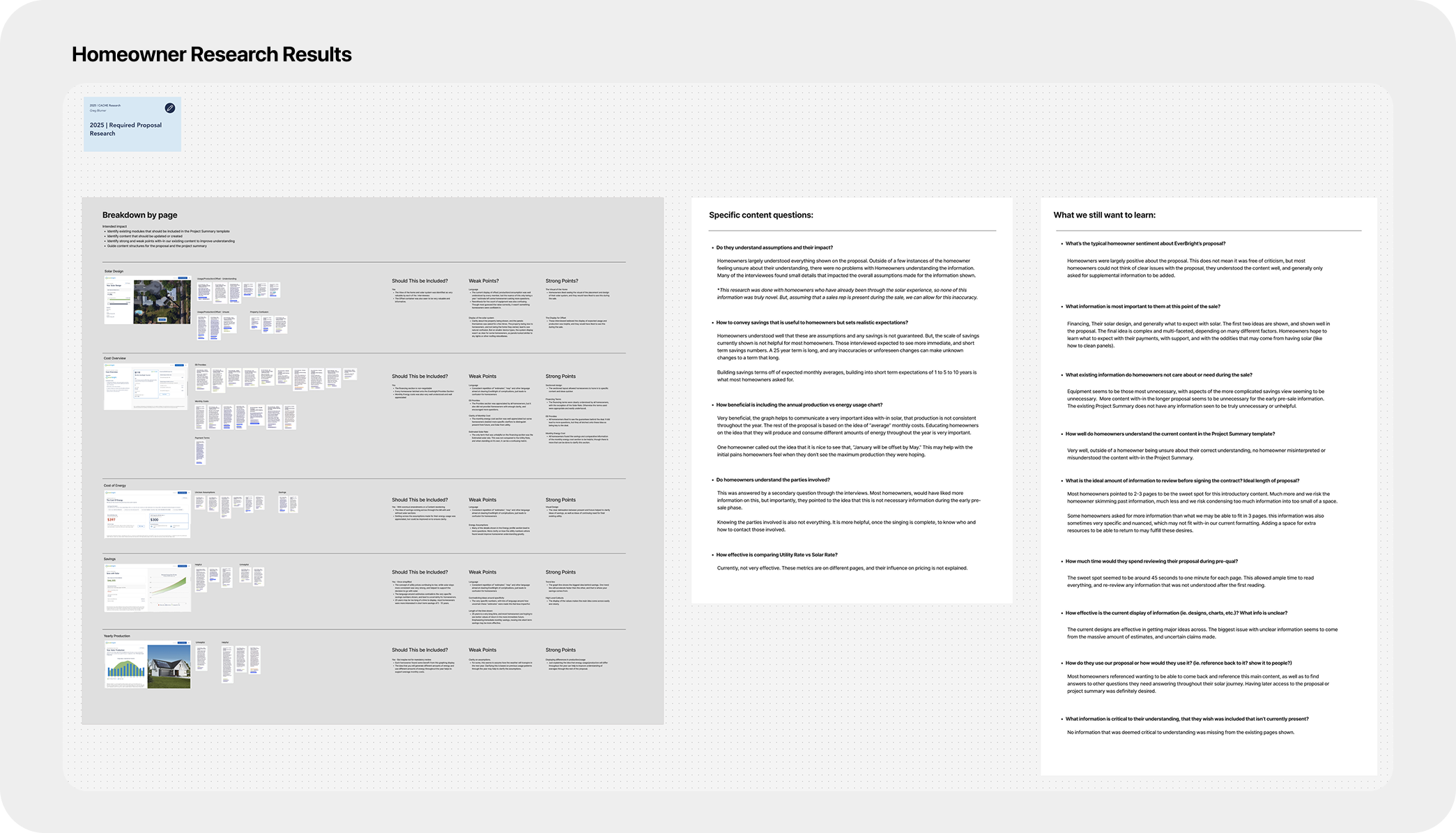
While we were working through the initial content updates, we were also setting up the infrastructure for homeowner research.
As we worked with compliance and legal to confirm our content updates, and handed off the improvements to our development team, we began to learn about the homeowner experience and to test our improvements.
Homeowner Research and Testing
The first task behind updating our content was refining the existing content and design structures. The existing structure had no rules around spacing, character limits, or responsive behavior. The most common device type used for the proposal was a tablet, and in the existing state, the tablet view was broken. So our first task as to create consistent spacing rules and applied responsive views that prioritized tablet, mobile, and pdf printing. For this I oversaw a Junior Designer and led them through this process.
The next challenge was to work through our disclaimers. With the current content being incorrect and rife with legal and compliance issues, we needed to work with our internal partners to rework this content. Legal and compliance naturally take time with this content, so we started our content updates by sending them the required and expected updates.
Finally we began updating the content. We knew that easy wins would come with removing unknown terms, and simplifying language around complex issues. Next, using the sales rep research, we knew terms and ideas that needed to be added.
Stage 1.
Utilizing Research and Designing in Parallel
We eventually released the proposal content updates, but as we expected it did not have the complete effect we needed to make an impact. Sales reps, were still free to show what content they wanted to the homeowner, and these content improvements, though necessary, did not insert EverBright into the sales experience.What we needed was a way to ensure homeowners saw our content before finalizing any decision.
Features to Interrupt the Process
The first task behind updating our content was refining the existing content and design structures. The existing structure had no rules around spacing, character limits, or responsive behavior. The most common device type used for the proposal was a tablet, and in the existing state, the tablet view was broken. So our first task as to create consistent spacing rules and applied responsive views that prioritized tablet, mobile, and pdf printing. For this I oversaw a Junior Designer and led them through this process.
The next challenge was to work through our disclaimers. With the current content being incorrect and rife with legal and compliance issues, we needed to work with our internal partners to rework this content. Legal and compliance naturally take time with this content, so we started our content updates by sending them the required and expected updates.
Finally we began updating the content. We knew that easy wins would come with removing unknown terms, and simplifying language around complex issues. Next, using the sales rep research, we knew terms and ideas that needed to be added.
Stage 1.
Utilizing Research and Designing in Parallel
The implementation of the new feature made for drastic improvements to our education visibility and had a measurable impact on deal quality. But this was still the fastest way we could implement changes and it came with drawbacks. Next, we wanted to find a way to better insert ourselves into the sales process and better introduce EverBright to the homeowner.
Account Creation and Next Steps
The first task behind updating our content was refining the existing content and design structures. The existing structure had no rules around spacing, character limits, or responsive behavior. The most common device type used for the proposal was a tablet, and in the existing state, the tablet view was broken. So our first task as to create consistent spacing rules and applied responsive views that prioritized tablet, mobile, and pdf printing. For this I oversaw a Junior Designer and led them through this process.
The next challenge was to work through our disclaimers. With the current content being incorrect and rife with legal and compliance issues, we needed to work with our internal partners to rework this content. Legal and compliance naturally take time with this content, so we started our content updates by sending them the required and expected updates.
Finally we began updating the content. We knew that easy wins would come with removing unknown terms, and simplifying language around complex issues. Next, using the sales rep research, we knew terms and ideas that needed to be added.
Impacts Revisited
10% → 90%
Percentage of Homeowners viewing the proposal for at least 90 seconds.
27% → 87%
Homeowners that viewed a proposal before signing a contract.
+918%
Increase in rate of completed proposal review.
These numbers highlights both the impact, and the fault of the strategy we chose. We were able to drastically improve our impact with homeowners, but due to our existing platform rules, there were ways around this solution that we could not solve for.
+19%
Homeowners that viewed a proposal before signing a contract.
This metric does include the full company effort to improve the relationship with homeowners, but an increase of this level still points to the effectiveness these improvements.
Impact
Agile works well with ambiguity.
Improvements are improvements, waiting for the perfect solution can cost money. Ship what you know will make an impact, learn from it, and iterate again.
Ask questions, follow with research.
Highlight every unknown, it will challenge what you do know, and will help to narrow down what needs to be discovered. Then do not skimp on the research. Even late in the process, research is much less expensive than shipping something that does not work.
Long term plans makes adapting easier.
Whether or not you have plans to return to any given work, plan for what comes next. This will help with decision making, encourage buy in from stakeholders, and allow for easier adaptations than starting anew.
Impact
Product Design
Design Handoff, Communication with Product and Engineering, Design Critiques with Leadership.
UX Design
Wireframes, Rapid Prototyping, Information Architecture, Content Hierarchies, Site-maping, Interaction Patterns.
UI Design
User journeys, Competitive Analysis, User Surveys, User Interviews.
User Research
Design System Audit, Component Creation.
UX Writing / Content Design
Combining with Marketing, Legal, Compliance, and Sales for Content Styling, Toning and Clarity.
Contact @:
gregory.blumer@gmail.com
LinkedIn:
linkedin.com/in/gregory-blumer/
Work
About
Gregory Blumer
EverBright
Case Study in Strategic Product Design
June 2024 - July 2025
Solar Proposal Redesign
Utilizing user research and scalable design to solve an industry wide problem costing EverBright millions.
EverBright, a company focused on residential solar financing and design, was dealing with high rates of homeowner delinquency due to excessive homeowner dissatisfaction, deceptive sales practices, and poorly defined educational materials.Working with external sales representatives, EverBright had no presence during in the sales process. The materials that did make it to the homeowners were convoluted, and easy to misunderstand. This led to homeowners not understanding their payments, the impact of solar, and the extent of EverBright’s involvement.This problem plagued other solar competitors and cost EverBright alone more than 100 million in 2024/2025.
Impact
$42 million
Potential risk savings by improving proposal views before contract signing by 60%.
$42 million
Potential risk savings by improving proposal views before contract signing by 60%.
$42 million
Potential risk savings by improving proposal views before contract signing by 60%.
Joining the Team
I joined EverBright in 2023 as a Senior Product Designer, and through 2024 I helped to design new features for the B2B, Solar Design and Financing platform with-in EverBright.
In the summer of 2024, I changed teams and focuses to B2C, Homeowner-facing support and education products. As I shifted into this space I was tasked to lead the design efforts to solve for the 3 major problems plaguing EverBright.
Core Problems
Homeowners dissatisfaction and delinquency.
The core problem is our end customer is unsatisfied, leading to financial delinquencies, poor brand reputation, and legal battles. Nothing outranks this priority, but it still leaves us with many questions.
Complicated and poorly defined content.
The content EverBright used had clearly not been updated in many years. The existing materials leaned into selling more than informing. We quickly learned that sales reps were not using our provided tools or materials for homeowner education.
Improper and deceptive sales practices.
Sales reps are incentivized to close deals quickly, and that in turn means some information is missing. Homeowners, of course want as much information as possible to be as informed as possible. This obvious tension must be solved by EverBright to salvage both relationships.
Strategy
These problems were actively effecting the business and could not wait for long research and development cycles, so we needed to be scrappy in our strategy.We needed to answer the questions critical to our understanding of the problem, but while we were learning, we could tackle the foundational work and any clear improvements. As timing with other initiatives worked out we began with research on the sales rep while we solved direct content issues. This would inform our direction towards more complete solutions past content updates, like new features or process improvements that may require more product strategy.Once we had some early solutions and improvements designed, and we had successfully set up research infrastructures with homeowners, we would then test our solutions while answering our questions about the sales process from the lens of the homeowner.Lastly we would implement yet unknown feature and process improvements based on our research learnings to solve for the core problems outside of our content.
Stage 1.
Utilizing Research and Designing in Parallel
Naturally when you are left with this many questions, you have to start with research. There was much we wanted to learn about the sales rep, the homeowner, and the sales process as a whole.Research was a challenge at EverBright. There were no existing structures, and no immediate ways to contact sales reps or homeowners due to internal restrictions.With problems of this scale, we could not wait on building research infrastructures. So as we began research, we needed to get a start on reworking content and the core materials.
Sales Reps Research
As I began with this new team, a partner team focused on solar design tools for sales reps began their own research efforts. Luckily we were able to use their infrastructure, and interviews to insert our own questions. This allowed us to begin research faster, get a more educated start on content redesigns, as well as assist their team in analyzing and sharing research results.
Through this research we learned that the proposal was not being used. Sales reps were instead selling through conversation, leaving very little behind for homeowners to refer to. They wanted to sell reactively based on homeowner needs, and without complete control over the content, sales reps did not want to use our materials. Specifically, reps found our content to have too much unnecessary information, with not enough focus on terms of service or guarantees.
Initial learnings from our sales reps confirmed our strategy to begin reworking content with the idea of simplifying and de-risking our materials. Understanding that it would be an uphill battle to encourage or force sales reps to use our content, we refocused on directing our efforts on the homeowner.
Simplifying Content and Removing Risk
The first task behind updating our content was refining the existing content and design structures. The existing structure had no rules around spacing, character limits, or responsive behavior. The most common device type used for the proposal was a tablet, and in the existing state, the tablet view was broken. So our first task as to create consistent spacing rules and applied responsive views that prioritized tablet, mobile, and pdf printing. For this I oversaw a Junior Designer and led them through this process.
The next challenge was to work through our disclaimers. With the current content being incorrect and rife with legal and compliance issues, we needed to work with our internal partners to rework this content. Legal and compliance naturally take time with this content, so we started our content updates by sending them the required and expected updates.
Finally we began updating the content. We knew that easy wins would come with removing unknown terms, and simplifying language around complex issues. Next, using the sales rep research, we knew terms and ideas that needed to be added.
Stage 1.
Utilizing Research and Designing in Parallel
While we were working through the initial content updates, we were also setting up the infrastructure for homeowner research.
As we worked with compliance and legal to confirm our content updates, and handed off the improvements to our development team, we began to learn about the homeowner experience and to test our improvements.
Homeowner Research and Testing
The first task behind updating our content was refining the existing content and design structures. The existing structure had no rules around spacing, character limits, or responsive behavior. The most common device type used for the proposal was a tablet, and in the existing state, the tablet view was broken. So our first task as to create consistent spacing rules and applied responsive views that prioritized tablet, mobile, and pdf printing. For this I oversaw a Junior Designer and led them through this process.
The next challenge was to work through our disclaimers. With the current content being incorrect and rife with legal and compliance issues, we needed to work with our internal partners to rework this content. Legal and compliance naturally take time with this content, so we started our content updates by sending them the required and expected updates.
Finally we began updating the content. We knew that easy wins would come with removing unknown terms, and simplifying language around complex issues. Next, using the sales rep research, we knew terms and ideas that needed to be added.
Stage 1.
Utilizing Research and Designing in Parallel
We eventually released the proposal content updates, but as we expected it did not have the complete effect we needed to make an impact. Sales reps, were still free to show what content they wanted to the homeowner, and these content improvements, though necessary, did not insert EverBright into the sales experience.What we needed was a way to ensure homeowners saw our content before finalizing any decision.
Features to Interrupt the Process
The first task behind updating our content was refining the existing content and design structures. The existing structure had no rules around spacing, character limits, or responsive behavior. The most common device type used for the proposal was a tablet, and in the existing state, the tablet view was broken. So our first task as to create consistent spacing rules and applied responsive views that prioritized tablet, mobile, and pdf printing. For this I oversaw a Junior Designer and led them through this process.
The next challenge was to work through our disclaimers. With the current content being incorrect and rife with legal and compliance issues, we needed to work with our internal partners to rework this content. Legal and compliance naturally take time with this content, so we started our content updates by sending them the required and expected updates.
Finally we began updating the content. We knew that easy wins would come with removing unknown terms, and simplifying language around complex issues. Next, using the sales rep research, we knew terms and ideas that needed to be added.
Stage 1.
Utilizing Research and Designing in Parallel
The implementation of the new feature made for drastic improvements to our education visibility and had a measurable impact on deal quality. But this was still the fastest way we could implement changes and it came with drawbacks. Next, we wanted to find a way to better insert ourselves into the sales process and better introduce EverBright to the homeowner.
Account Creation and Next Steps
The first task behind updating our content was refining the existing content and design structures. The existing structure had no rules around spacing, character limits, or responsive behavior. The most common device type used for the proposal was a tablet, and in the existing state, the tablet view was broken. So our first task as to create consistent spacing rules and applied responsive views that prioritized tablet, mobile, and pdf printing. For this I oversaw a Junior Designer and led them through this process.
The next challenge was to work through our disclaimers. With the current content being incorrect and rife with legal and compliance issues, we needed to work with our internal partners to rework this content. Legal and compliance naturally take time with this content, so we started our content updates by sending them the required and expected updates.
Finally we began updating the content. We knew that easy wins would come with removing unknown terms, and simplifying language around complex issues. Next, using the sales rep research, we knew terms and ideas that needed to be added.
Impacts Revisited
10% → 90%
Percentage of Homeowners viewing the proposal for at least 90 seconds.
27% → 87%
Homeowners that viewed a proposal before signing a contract.
+918%
Increase in rate of completed proposal review.
These numbers highlights both the impact, and the fault of the strategy we chose. We were able to drastically improve our impact with homeowners, but due to our existing platform rules, there were ways around this solution that we could not solve for.
+19%
Homeowners that viewed a proposal before signing a contract.
This metric does include the full company effort to improve the relationship with homeowners, but an increase of this level still points to the effectiveness these improvements.
Takeaways
Agile works well with ambiguity.
Improvements are improvements, waiting for the perfect solution can cost money. Ship what you know will make an impact, learn from it, and iterate again.
Ask questions, follow with research.
Highlight every unknown, it will challenge what you do know, and will help to narrow down what needs to be discovered. Then do not skimp on the research. Even late in the process, research is much less expensive than shipping something that does not work.
Designing systems for scale saves time.
It is tempting to build just what you need, but if you do not have plans to return to any given work, designing for scale will save you time. It helps you design to set rules, and helps to communicate decisions to engineers.
Long term plans makes adapting easier.
Whether or not you have plans to return to any given work, plan for what comes next. This will help with decision making, encourage buy in from stakeholders, and allow for easier adaptations than starting anew.
My Contributions:
Product Design
Design Handoff, Communication with Product and Engineering, Design Critiques with Leadership.
UX Design
Wireframes, Rapid Prototyping, Information Architecture, Content Hierarchies, Site-maping, Interaction Patterns.
UI Design
Design System Audit, Component Creation.
User Research
User journeys, Competitive Analysis, User Surveys, User Interviews.
UX Writing / Content Design
Combining with Marketing, Legal, Compliance, and Sales for Content Styling, Toning and Clarity.
Contact @:
gregory.blumer@gmail.com
LinkedIn:
linkedin.com/in/gregory-blumer/
EverBright
Case Study in Strategic Product Design
June 2024 - July 2025
Solar Proposal Redesign
Utilizing user research and scalable design to solve an industry wide problem costing EverBright millions.
EverBright, a company focused on residential solar financing and design, was dealing with high rates of homeowner delinquency due to excessive homeowner dissatisfaction, deceptive sales practices, and poorly defined educational materials.Working with external sales representatives, EverBright had no presence during in the sales process. The materials that did make it to the homeowners were convoluted, and easy to misunderstand. This led to homeowners not understanding their payments, the impact of solar, and the extent of EverBright’s involvement.This problem plagued other solar competitors and cost EverBright alone more than 100 million in 2024/2025.
Impact
$42 million
Potential risk savings by improving proposal views before contract signing by 60%.
10% → 90%
Percentage of Homeowners viewing the proposal for at least 90 seconds.
27% → 87%
Homeowners that viewed a proposal before signing a contract.
Joining the Team
I joined EverBright in 2023 as a Senior Product Designer, and through 2024 I helped to design new features for the B2B, Solar Design and Financing platform with-in EverBright.
In the summer of 2024, I changed teams and focuses to B2C, Homeowner-facing support and education products. As I shifted into this space I was tasked to lead the design efforts to solve for the 3 major problems plaguing EverBright.
Core Problems
Homeowners dissatisfaction and delinquency.
The core problem is our end customer is unsatisfied, leading to financial delinquencies, poor brand reputation, and legal battles. Nothing outranks this priority, but it still leaves us with many questions.
Complicated and poorly defined content.
The content EverBright used had clearly not been updated in many years. The existing materials leaned into selling more than informing. We quickly learned that sales reps were not using our provided tools or materials for homeowner education.
Improper and deceptive sales practices.
Sales reps are incentivized to close deals quickly, and that in turn means some information is missing. Homeowners, of course want as much information as possible to be as informed as possible. This obvious tension must be solved by EverBright to salvage both relationships.
Strategy
These problems were actively effecting the business and could not wait for long research and development cycles, so we needed to be scrappy in our strategy.We needed to answer the questions critical to our understanding of the problem, but while we were learning, we could tackle the foundational work and any clear improvements. As timing with other initiatives worked out we began with research on the sales rep while we solved direct content issues. This would inform our direction towards more complete solutions past content updates, like new features or process improvements that may require more product strategy.Once we had some early solutions and improvements designed, and we had successfully set up research infrastructures with homeowners, we would then test our solutions while answering our questions about the sales process from the lens of the homeowner.Lastly we would implement yet unknown feature and process improvements based on our research learnings to solve for the core problems outside of our content.
Stage 1.
Utilizing Research and Designing in Parallel
Naturally when you are left with this many questions, you have to start with research. There was much we wanted to learn about the sales rep, the homeowner, and the sales process as a whole.Research was a challenge at EverBright. There were no existing structures, and no immediate ways to contact sales reps or homeowners due to internal restrictions.With problems of this scale, we could not wait on building research infrastructures. So as we began research, we needed to get a start on reworking content and the core materials.
Sales Reps Research
As I began with this new team, a partner team focused on solar design tools for sales reps began their own research efforts. Luckily we were able to use their infrastructure, and interviews to insert our own questions. This allowed us to begin research faster, get a more educated start on content redesigns, as well as assist their team in analyzing and sharing research results.
Through this research we learned that the proposal was not being used. Sales reps were instead selling through conversation, leaving very little behind for homeowners to refer to. They wanted to sell reactively based on homeowner needs, and without complete control over the content, sales reps did not want to use our materials. Specifically, reps found our content to have too much unnecessary information, with not enough focus on terms of service or guarantees.
Initial learnings from our sales reps confirmed our strategy to begin reworking content with the idea of simplifying and de-risking our materials. Understanding that it would be an uphill battle to encourage or force sales reps to use our content, we refocused on directing our efforts on the homeowner.
Simplifying Content and Removing Risk
The first task behind updating our content was refining the existing content and design structures. The existing structure had no rules around spacing, character limits, or responsive behavior. The most common device type used for the proposal was a tablet, and in the existing state, the tablet view was broken. So our first task as to create consistent spacing rules and applied responsive views that prioritized tablet, mobile, and pdf printing. For this I oversaw a Junior Designer and led them through this process.
The next challenge was to work through our disclaimers. With the current content being incorrect and rife with legal and compliance issues, we needed to work with our internal partners to rework this content. Legal and compliance naturally take time with this content, so we started our content updates by sending them the required and expected updates.
Finally we began updating the content. We knew that easy wins would come with removing unknown terms, and simplifying language around complex issues. Next, using the sales rep research, we knew terms and ideas that needed to be added.
Stage 2.
Research and Testing
While we were working through the initial content updates, we were also setting up the infrastructure for homeowner research.
As we worked with compliance and legal to confirm our content updates, and handed off the improvements to our development team, we began to learn about the homeowner experience and to test our improvements.
Homeowner Research and Testing
Thanks to our marketing and customer success teams, we were able to reach out to our recently added homeowners, and eventually interviewed 12 homeowners about their experience.
Thanks to this research we were able to answer the majority of our remaining questions, confirm and improve our content updates, and build confidence in our feature improvement strategy. Best of all, we were able to finally build an educated model of our core customer and share that out with the rest of the organization, refocusing efforts at improving the homeowner experience.
Stage 3.
Feature Implementation
We eventually released the proposal content updates, but as we expected it did not have the complete effect we needed to make an impact. Sales reps, were still free to show what content they wanted to the homeowner, and these content improvements, though necessary, did not insert EverBright into the sales experience.What we needed was a way to ensure homeowners saw our content before finalizing any decision.
Features to Interrupt the Process
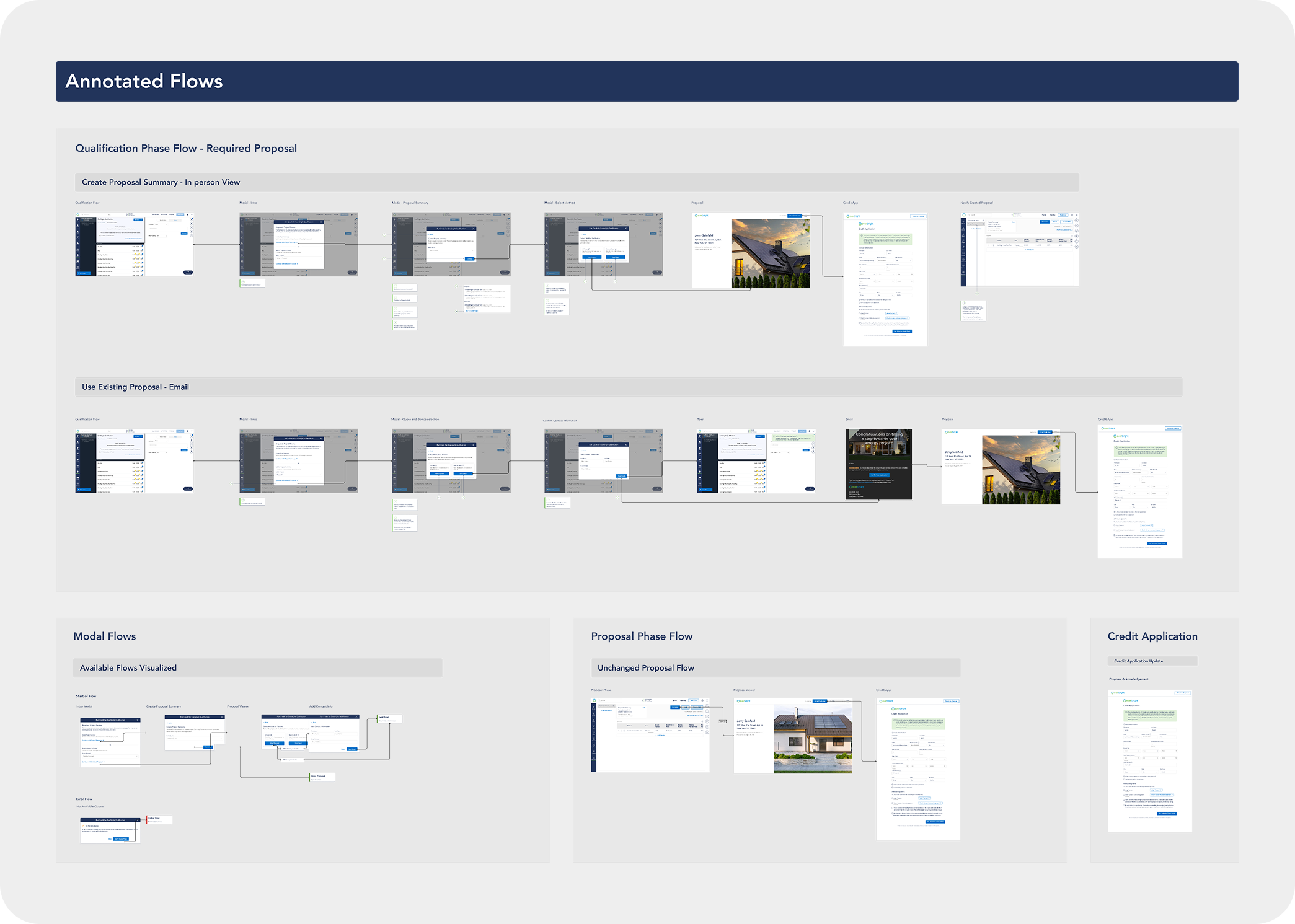
With-in our design and financing process, there was one spot where we could insert ourselves to the right effect. We chose right before the financing credit approval step, because any earlier, they may not have a complete solar design and financing project, and any later may be too late, creating frustration with Sales reps by adding road blocks before a final signature.The feature solution was a fairly straight forward change, requiring the homeowner to review all of a shortened version of our new proposal, before applying for a credit check. With there being a grace period after credit application and the contract signature, we also decided to send the homeowners a complete form of the new proposal content through email, with messaging encouraging a full review.
Stage 3.
Planning for Future Improvements
The implementation of the new feature made for drastic improvements to our education visibility and had a measurable impact on deal quality. But this was still the fastest way we could implement changes and it came with drawbacks. Next, we wanted to find a way to better insert ourselves into the sales process and better introduce EverBright to the homeowner.
Account Creation and Next Steps
Once the homeowner had signed a contract, they were invited to join MyEverBright, an app allowing them to track their solar production, pay their bills, and get support for any issues. We struggled to encourage users to engage with the app, but with a mandatory onboarding being released soon, we were encouraged that this platform could allow us to better interact with our homeowners.The idea was simple, bring the complete homeowner experience into MyEverBright. This included bringing the solar proposal, credit application, and contract signing into the app. We originally wanted to go with this direction, but with limited resources and high stakes, we needed to implement a solution with-in the existing tech structures.As we were developing the final solutions, we began to plan and explore solutions to completely overhaul the homeowner experience....
... Unfortunately here is where the story ends. Due to priority shifts and major company changes, we were never able to follow through on the complete improvements.
Impacts Revisited
10% → 90%
Percentage of Homeowners viewing the proposal for at least 90 seconds.
27% → 87%
Homeowners that viewed a proposal before signing a contract.
+918%
Increase in rate of completed proposal review.
These numbers highlights both the impact, and the fault of the strategy we chose. We were able to drastically improve our impact with homeowners, but due to our existing platform rules, there were ways around this solution that we could not solve for.
+19%
Homeowners that viewed a proposal before signing a contract.
This metric does include the full company effort to improve the relationship with homeowners, but an increase of this level still points to the effectiveness these improvements.
Takeaways
Agile works well with ambiguity.
Improvements are improvements, waiting for the perfect solution can cost money. Ship what you know will make an impact, learn from it, and iterate again.
Ask questions, follow with research.
Highlight every unknown, it will challenge what you do know, and will help to narrow down what needs to be discovered. Then do not skimp on the research. Even late in the process, research is much less expensive than shipping something that does not work.
Designing systems for scale saves time.
It is tempting to build just what you need, but if you do not have plans to return to any given work, designing for scale will save you time. It helps you design to set rules, and helps to communicate decisions to engineers.
Long term plans makes adapting easier.
Whether or not you have plans to return to any given work, plan for what comes next. This will help with decision making, encourage buy in from stakeholders, and allow for easier adaptations than starting anew.
My Contributions:
Product Design
Design Handoff, Communication with Product and Engineering, Design Critiques with Leadership.
UX Design
Wireframes, Rapid Prototyping, Information Architecture, Content Hierarchies, Site-maping, Interaction Patterns.
UI Design
Design System Audit, Component Creation.
User Research
User journeys, Competitive Analysis, User Surveys, User Interviews.
UX Writing / Content Design
Combining with Marketing, Legal, Compliance, and Sales for Content Styling, Toning and Clarity.
Contact @:
gregory.blumer@gmail.com
LinkedIn:
linkedin.com/in/gregory-blumer/